Showing posts with label loss. Show all posts

Wednesday, December 15, 2010

Healing the Hurt, Restoring the Hope: Take VIII

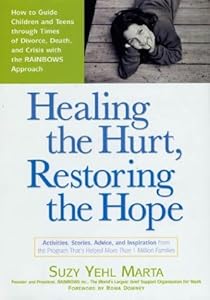
I've finished reading Healing the Hurt, Restoring the Hope:  How to Guide Children and Teens through Times of Divorce, Death, and Crisis with the RAINBOWS Approach by Suzy Yehl Marta. It's an excellent book.  There are very little things I would criticize (like the idea that if a child's hair is unkempt, clearly there are issues at home) but I really think that this book is useful for anyone who spends time with children, anyone who wants to be what Marta calls a compassionate companion.  I encourage you to pick it up, as different parts will stand out for each reader.


The rest of my notes/thoughts on the book:


Chapter 9, Activities & Rituals for Healing is just full of activities that can be done individually or with groups of children.  Chapter 10, Troubleshooting, addresses various problematic behaviors, where they might come from, and ways to address the behavior and talk with the child.

Chapter 11 -- Still a Family

". . . while you have severed your marriage bond with your spouse, the bond between child and parent . . . needs to remain strong and unquestioned . . . it is crucial that he's able to interact freely in both your family and your former spouse's.  To exclude members of the child's "other" family is to exclude a part of the child's very identity and can only end up hurting the child." (292)


"A complete divorce involves three elements:  legal, physical, and emotional.  Until all three are accomplished, you are not fully divorced . . . the emotional part of divorce can take years to achieve and can only be accomplished by you.  Yet divorcing yourself emotionally from your spouse and rebuilding a separate, positive, nurturing life is the most essential of these tasks -- and the most crucial one for allowing your children to heal and rebuild their own lives." (296)

"As parents, we owe it to our kids to recognize the destructive nature of our hostility and bitterness.  Despite what happened in the past, each child is entitled to two parents who are mature, responsible, and concerned enough to shelve their anger and work toward creating an environment where their children can interact comfortably with all members of their family." (299)


Marta talks about maintaining daily contact with your child whether she is with you or not.  This is something that Jeremy and I haven't really been doing and I think it is a good idea.  Just a phone call to check in and let her know we think about her even when she is not with us.   She also raises the issue of how to refer to a child's two houses - "your dad's/mom's house" takes from the child any ownership or sense of belonging.  She suggests using "your home with your mom" or "your home with your dad".  While this seems like such a small thing, it  makes sense to me and I hope to share this idea with others who are involved in Fiona's life.


Some tips for helping your child transition between houses:
*Send the children off to have a good time; be cheerful and encouraging.
*Before the children leave, remind them to love their other parent and enjoy their time with him or her.
*Never discuss issues or problems in front of the children, even though it may seem convenient to bring up conflicts while the kids are being picked up or dropped off.
*Establish goodbye and welcome-home traditions to ease the transitions.  (306-7)


Chapter 12 -- Caring Communities:  Shaping a Brighter Future


"Hope is what lights the path to reconciling loss.  It is a voice that continually says:  I will get better. Life will be better.  The pain will eventually go away. We need to offer hope as the incentive for navigating all of the difficult phases of mourning.  Hope makes grieving possible. . . By acting as compassionate companions, we give bereaved youth the only reassurance they have that their fundamental needs will be met." (311)


Epilogue: (Marta is talking about her own blended family, now that her children are adults.)


"Collectively, we try to look though the lens of what is best for the children and grandchildren.  Admittedly, sometimes the eyepiece gets clouded with hurt feelings or crummy attitudes, but we just keep polishing the glass to keep it clear and focused on the children." (329-30)

Monday, December 13, 2010

Healing the Hurt, Restoring the Hope: Take VII


Healing the Hurt, Restoring the Hope:  How to Guide Children and Teens through Times of Divorce, Death, and Crisis with the RAINBOWS Approach by Suzy Yehl Marta

Chapter 8 -- Heartfelt Conversations

". . . talking about the loss event is crucial to the four stepping stones of healing . . . As children are able to release their pent-up grief emotions and express them out loud, they are finally able to begin sorting through the pieces of their loss.  It is only then that they can reassemble their worlds.  The process is similar to doing a jigsaw puzzle . . . You opened the box, dumped out the pieces, turned them all over, and sorted through them.  Only after you were able to evaluate all the pieces and arrange them in some kind of order were you able to put together the picture.  Grief is the same way." (192)

Marta encourages compassionate companions, those who are walking alongside the child, not to give up, that it may take a while for the child to share what's inside -- but to persist, gently, and be patient.  "If, after a few nudges, the child doesn't seem to want to talk about the loss, let go of the topic.  Instead, engage him in conversation about the news, sports, movies -- any subject that interests him.  A grieving child cannot flip the 'on' switch and discuss a painful loss just because you are ready to talk about the event.  Later, on a different occasion, reach out to him again." (198)  She also recommends avoiding "why" questions because they ask the child to defend or explain his/her feelings.  Rather, she suggests, ask questions like, "Could you describe the events that caused you to feel this way?" (194)

Three messages a compassionate companion wants to communicate to a grieving child:
  • You exist.
  • You are worthwhile.
  • What you feel, fear, and know is important -- and important to me. (202)
". . . you must be able to stand alongside the grieving child and let her work through her grief.  Inner strength and personal growth will come to her as she works through the problem.  The highest gift you can give the struggling child is the chance to express herself and reach her own conclusions about her needs and future." (207)

Marta suggests making time to interact with your child creatively -- caring for dolls, telling stories, role-playing -- "Remember, if play is the work of childhood and grief is work, then given the opportunity, a child will grieve through play." (207)  Children and teens can make a sculpture of their loss, draw their thoughts and feelings, create music.

This chapter is full of tips and ideas for how best to talk with children about their loss -- including how not to talk!  The main point of the chapter?  "Once their emotions and concerns are acknowledged, the children can begin to do the work that grief requires." (212)


Friday, December 10, 2010

Healing the Hurt, Restoring the Hope: Take VI


Healing the Hurt, Restoring the Hope:  How to Guide Children and Teens through Times of Divorce, Death, and Crisis with the RAINBOWS Approach by Suzy Yehl Marta

Chapter Seven:  Four Stepping Stones to Healing (178-88)
  • Comprehending -- "The easiest way to help a child comprehend what has happened is to ask him to share his story -- what happened to him and how it has changed his life.  Not once.  Not twice.  But many times." (179)  

Marta says children need to be able to tell their story at least 30 times -- whether the story is told 30 times to one person or once to 30 people.  She brings up a great point when she reminds us that, as children grow and mature, their view of their own story will also change and that each new stage may bring a need to retell their story with new understanding.  Another suggestion for children as they struggle to come to terms with what is happening -- ask them to tell you in their own words what they believe has happened/is happening.
  • Mourning -- "Our role as compassionate companions is to encourage grieving children to verbalize their feelings of loss.  Once these feelings are outside -- in the light -- the kids will be less afraid.  Once the conflicting emotions are outside of their hearts, they will have power over the loss event.  Then they can begin the work of healing their hurt and moving on." (181-2)
  • Commemorating -- "Most children need to be assured that it's okay for them to cherish their memories . . . If they are told not to mention happy memories or good times that occurred before the loss, they are being asked to deny who they are and their personal history. . . The truth is that commemorating teaches children that life has value.  Remembering teaches that love is important, despite the emotional pain that may accompany it.  After a life-altering event . . . children need to establish ways to remember the absent person and the family as it existed before the loss event." (184)
  •  
      Marta lists ways you can help children.  With divorce:  
      "The family's roots need to be honored for the sake of the children. This can be done by:
      *Keeping all family photo albums and wedding pictures
      *Saving keepsakes and heirlooms for the children
      *Passing on family jewelry such as the engagement or wedding rings
      *Sharing why you fell in love with your child's parent
      *Talking about your former spouse's good qualities and traits
      *Reminiscing about the happier times" (185)
    • Moving Forward
              "After a divorce, a child m ay refuse to accept the reality of her new life.  She clings to the past as a way of preserving the nuclear family she had once been part of.  You can assure the child that her parents will always love her.  Help her recognize that she can have strong, loving, separate, individual, relationships with each of her parents . . . reassure the child with comments such as, 'This is not about you.  It's about your parent's own capabilities.  You are not responsible for your mother's (father's) actions.'" (187-8)


    Monday, November 29, 2010

    Healing the Hurt, Restoring the Hope: Take V

    From Chapter 6, Becoming a Compassionate Companion:

    "Often, children try to ignore or deny the pain of loss, rather than admit to and deal with it.  They usually do so for one or more of these three reasons.
    • They are determined to be strong.  Therefore they 'stuff' their pain and feelings inside, put on a stoic face, and stalwartly go on with life, much to the relief of family and friends.
    • They are simply too afraid of these unfamiliar feelings to say them out loud.
    • No one has asked the child how she is feeling.  Subsequently, she thinks there's something wrong with herself and tries to push away or deny her feelings.
    . . . these 'coping' responses only delay a child's healing and his return to feeling better." p.170

    "No matter how friendly their parents act during a divorce, in their heart of hearts, the children are distressed.  They don't want their mom and dad to dissolve the marriage; they don't want to settle for seeing one parent on a part-time basis." p. 171

    "Remember that to emotionally survive a death, separation, divorce, or family crisis, children need:
    • Sufficient time to mourn the profound change that has occurred
    • Permission to cry
    • Knowledgeable, caring adults who reach out and support them." p. 177  

    Thursday, November 18, 2010

    Healing the Hurt, Restoring the Hope: Take I

    I've been reading Healing the Hurt, Restoring the Hope:  How to Guide Children and Teens through Times of Divorce, Death, and Crisis with the RAINBOWS Approach by Suzy Yehl Marta.  I'll probably keep sharing little snippets because it's some good stuff.  I'm finding it saddening and sobering yet also hopeful.  I'm so sad for my daughter in so many ways, and for myself and my husband.  And yet, in my most rational moments, I am convinced that moving in this direction will bring more eventual joy than sorrow.  At two o'clock in the morning when I can't sleep and everything feels so very impossible -- it's a bit more difficult to believe.

    The following are direct quotes from the book.


    Adults rely on a long string of accumulated life experiences to prepare for new circumstances.  Kids don't have that crutch.  They're facing life events for the first time.  More often than not, they really don't know what to expect.  It's understandable, then, that new situations evoke feelings of fear and nervousness about how they'll cope and if they'll be able to get through the situation successfully.  p.59

    A significant loss, such as a divorce or death, sends a child's world spinning out of control.  Everything he has held as normal or stable shifts and changes.  Realizing that he will never recapture what has been lost, the child is filled with sadness.  This usually signals that reality is setting in. p. 69

    A child's identity is intrinsically linked to her family.  She thinks of herself as being part of the family unit, linked by an emotional umbilical cord.  After a divorce, she needs two cords, one tying her to her mother . . . and one joining her to her father.  This new identity, or new linkage, can't be forged overnight.  It takes time and nurturing. . . for many children, identity begins with their name.  They may feel confused and abandoned if, after a divorce, their mother reclaims her maiden name.  If she later remarries and assumes her second husband's last name, the children are further removed from her. p. 71

    Throughout their lives, children of divorce are forced to make painful choices.  At a wedding or family celebration, they have to decide whom to invite, whom to talk to first, and with whom to sit.. .   [They] don't experience the pain of their parents' divorce or the death of a loved person just one time.  At various stages in life, the feelings of loss may be rekindled or the memory of the event resurrected, triggering a sad attack. {The author says that children experience sadness in waves -- imagine a child weeping over a sibling's death, then playing and laughing with friends, and later in the same day feeling depressed and hopeless -- and she refers to these moments as "sad attacks".}This can happen repeatedly as children mature and move into adulthood.  It can be a recurring trigger for sadness and depression. p. 72-3