Showing posts with label grief. Show all posts

Friday, December 10, 2010

Healing the Hurt, Restoring the Hope: Take VI


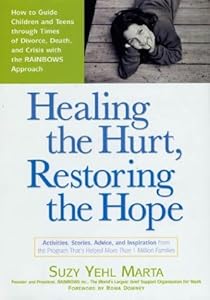
Healing the Hurt, Restoring the Hope:  How to Guide Children and Teens through Times of Divorce, Death, and Crisis with the RAINBOWS Approach by Suzy Yehl Marta

Chapter Seven:  Four Stepping Stones to Healing (178-88)
  • Comprehending -- "The easiest way to help a child comprehend what has happened is to ask him to share his story -- what happened to him and how it has changed his life.  Not once.  Not twice.  But many times." (179)  

Marta says children need to be able to tell their story at least 30 times -- whether the story is told 30 times to one person or once to 30 people.  She brings up a great point when she reminds us that, as children grow and mature, their view of their own story will also change and that each new stage may bring a need to retell their story with new understanding.  Another suggestion for children as they struggle to come to terms with what is happening -- ask them to tell you in their own words what they believe has happened/is happening.
  • Mourning -- "Our role as compassionate companions is to encourage grieving children to verbalize their feelings of loss.  Once these feelings are outside -- in the light -- the kids will be less afraid.  Once the conflicting emotions are outside of their hearts, they will have power over the loss event.  Then they can begin the work of healing their hurt and moving on." (181-2)
  • Commemorating -- "Most children need to be assured that it's okay for them to cherish their memories . . . If they are told not to mention happy memories or good times that occurred before the loss, they are being asked to deny who they are and their personal history. . . The truth is that commemorating teaches children that life has value.  Remembering teaches that love is important, despite the emotional pain that may accompany it.  After a life-altering event . . . children need to establish ways to remember the absent person and the family as it existed before the loss event." (184)
  •  
      Marta lists ways you can help children.  With divorce:  
      "The family's roots need to be honored for the sake of the children. This can be done by:
      *Keeping all family photo albums and wedding pictures
      *Saving keepsakes and heirlooms for the children
      *Passing on family jewelry such as the engagement or wedding rings
      *Sharing why you fell in love with your child's parent
      *Talking about your former spouse's good qualities and traits
      *Reminiscing about the happier times" (185)
    • Moving Forward
              "After a divorce, a child m ay refuse to accept the reality of her new life.  She clings to the past as a way of preserving the nuclear family she had once been part of.  You can assure the child that her parents will always love her.  Help her recognize that she can have strong, loving, separate, individual, relationships with each of her parents . . . reassure the child with comments such as, 'This is not about you.  It's about your parent's own capabilities.  You are not responsible for your mother's (father's) actions.'" (187-8)


    Thursday, November 18, 2010

    Healing the Hurt, Restoring the Hope: Take I

    I've been reading Healing the Hurt, Restoring the Hope:  How to Guide Children and Teens through Times of Divorce, Death, and Crisis with the RAINBOWS Approach by Suzy Yehl Marta.  I'll probably keep sharing little snippets because it's some good stuff.  I'm finding it saddening and sobering yet also hopeful.  I'm so sad for my daughter in so many ways, and for myself and my husband.  And yet, in my most rational moments, I am convinced that moving in this direction will bring more eventual joy than sorrow.  At two o'clock in the morning when I can't sleep and everything feels so very impossible -- it's a bit more difficult to believe.

    The following are direct quotes from the book.


    Adults rely on a long string of accumulated life experiences to prepare for new circumstances.  Kids don't have that crutch.  They're facing life events for the first time.  More often than not, they really don't know what to expect.  It's understandable, then, that new situations evoke feelings of fear and nervousness about how they'll cope and if they'll be able to get through the situation successfully.  p.59

    A significant loss, such as a divorce or death, sends a child's world spinning out of control.  Everything he has held as normal or stable shifts and changes.  Realizing that he will never recapture what has been lost, the child is filled with sadness.  This usually signals that reality is setting in. p. 69

    A child's identity is intrinsically linked to her family.  She thinks of herself as being part of the family unit, linked by an emotional umbilical cord.  After a divorce, she needs two cords, one tying her to her mother . . . and one joining her to her father.  This new identity, or new linkage, can't be forged overnight.  It takes time and nurturing. . . for many children, identity begins with their name.  They may feel confused and abandoned if, after a divorce, their mother reclaims her maiden name.  If she later remarries and assumes her second husband's last name, the children are further removed from her. p. 71

    Throughout their lives, children of divorce are forced to make painful choices.  At a wedding or family celebration, they have to decide whom to invite, whom to talk to first, and with whom to sit.. .   [They] don't experience the pain of their parents' divorce or the death of a loved person just one time.  At various stages in life, the feelings of loss may be rekindled or the memory of the event resurrected, triggering a sad attack. {The author says that children experience sadness in waves -- imagine a child weeping over a sibling's death, then playing and laughing with friends, and later in the same day feeling depressed and hopeless -- and she refers to these moments as "sad attacks".}This can happen repeatedly as children mature and move into adulthood.  It can be a recurring trigger for sadness and depression. p. 72-3