Showing posts with label death. Show all posts

Monday, May 30, 2011

What are you uncertain about?

Battlestar Galactica (2004 TV series)Image via Wikipedia
So Marc and Angel Hack Life had a blog post recently that asked 365 "thought-provoking questions".  I've picked some of the ones that stood out to me and hope to occasionally use them as writing prompts.

 What are you uncertain about?

Boy, at this exact point in my life, it feels like there are lots of things that I'm uncertain about.  I really have no idea what my life will look like in another 5 months, let alone 5 years.  I'm looking for both work and housing right now and I don't really have even the beginning of an idea of what either might look like.  On June 8th our divorce (and Fiona's name change) will most likely be final and hopefully at some point the settlement from my car/pedestrian accident will be finished as well -- though every so often I'm given a reminder that the physical ramifications will always be a part of my life.  This much uncertainty makes the ground beneath my feet feel pretty wobbly but the people around me do much to keep me on steady ground.

On a less practical/more philosophical note (though with no illusions that I have anything even slightly new or original to say on the subject), I realize more with each passing day that I'm not really sure what I think about life after death.  And as silly as this sounds, I think it was much more Battlestar Galactica than being hit by a car that made me start thinking much more about my own mortality and that of humankind in general. 

Friday, February 25, 2011

Blue by Lou Aronica -- Review and Contest!

From the back cover:

Chris Astor is a man in his early forties who is going through the toughest stretch of his life.


Becky is Chris's fourteen-year-old daughter, a girl who overcame enormous challenges to become a vibrant, vital young woman -- and now faces her greatest obstacle yet.


Miea is the young queen of a fantasy land that Becky and Chris created when Becky was little, a fantasy land that has developed a life of its own and now finds itself in terrible, maybe fatal, trouble.


Together, Chris, Becky, and Miea need to uncover a secret.  The secret to why their worlds have joined at this moment.  The secret to their purpose.  The secret to the future.   It is a secret that, when discovered, will redefine imagination for all of them.

Tamarisk is the imaginary world that Chris and Becky began imagining during a difficult time in her life.  When Chris and Polly (Becky's mother) divorced, Tamarisk was abandoned.  Becky begins to feel drawn back to Tamarisk and as she and Chris learn more about the blight affecting the crops there, they also, with Miea's help, begin to suspect that there is a way to save both Becky and Tamarisk at the same time.  So much to say about the way Aronica develops this story, but I don't want to give too much away!

Blue is making the rounds of other book blogs right now and I am interested to see what others have to say.  I wasn't sure what to make about one part of the storyline -- it might take a re-read for me to see more of the connections between Chris and Becky's world, Miea's world, and the observer (and perhaps orchestrator?) we read about in a few sparse sections of the book. 

A few random thoughts:

When Becky and her dad were instant-messaging I felt like Aronica did an excellent job of showing the subtle differences between the way a fourteen-year-old uses IM and the way her father uses the same technology -- it added to the believability/authenticity of the conversation.

I read Blue about four months after separating from my husband and so that part of the book felt especially poignant.  The reader learns a lot about Becky's feelings regarding her parents' divorce and also hears quite a bit from Chris's point of view. We don't hear as much from Polly, Becky's mother, and I think that it was good for me to have a chance to think more about the father's viewpoint.

Chris is thinking about Becky growing up -- such a bittersweet description:

When your child is born, each of her accomplishments seem to supersede the one before, and each makes you feel increasingly connected to her.  Simple biological need gives way to interaction, which gives way to meaningful conversation, and so on.  The relationship deepens with each stage.  At some point, though, you reach the top of the curve.  Your child continues to grow, to become a fuller and more substantial human being, but your association with these events become more distant.  She has meaningful conversations with her friends instead of you.  She learns critical life lessons away from the house.  She interacts more fully with the world and considerably less with you.  She looks to her future and sees a place where you are something just slightly more elevated than a number on her speed dial. Of course, if you are divorced from her mother . . . you descend the downside of the curve even faster.  (page 179)

All in all, a unique fantasy plot that includes so much real life as well.

CONTEST!!!

How often do you hear about something that sounds too good to be true? Well, I am here to offer 10 lucky winners the opportunity of a lifetime.

New York Times bestselling co-author, novelist, and former Publisher of Avon Books and Berkley Books, Lou Aronica has created a unique and exciting offer to anyone that is going to follow his upcoming book tour with Pump Up Your Book. His extensive experience in the publishing and editing fields has given him insight into an industry that continues to grow and change daily. Once again, that insight has led him to offer a contest that is truly special in so many ways. Lou will be accepting story pitches from followers of his blog tour. These story pitches must be for short stories pertaining to the fantasy world of his novel, “Blue.” This contest will allow 10 lucky people the opportunity of a lifetime, the chance to have their story published in an upcoming companion anthology to “Blue.” Lou will hand pick the winners, edit their stories, include them in the anthology and give them a pro-rated share of the royalties. How can you pass up an opportunity like this?

Now for the details:

The pitch should include a synopsis of the proposed story and a sample of the submitting author’s fiction writing. Specify the expected length of the story.

The pitch needs to be submitted by April 16, 2011
 

Please email your submission to Lou at laronica@fictionstudio.com

All winners will be notified by email by May 27, 2011.

Monday, November 29, 2010

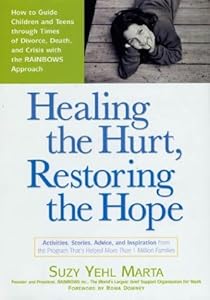
Healing the Hurt, Restoring the Hope: Take V

From Chapter 6, Becoming a Compassionate Companion:

"Often, children try to ignore or deny the pain of loss, rather than admit to and deal with it.  They usually do so for one or more of these three reasons.
  • They are determined to be strong.  Therefore they 'stuff' their pain and feelings inside, put on a stoic face, and stalwartly go on with life, much to the relief of family and friends.
  • They are simply too afraid of these unfamiliar feelings to say them out loud.
  • No one has asked the child how she is feeling.  Subsequently, she thinks there's something wrong with herself and tries to push away or deny her feelings.
. . . these 'coping' responses only delay a child's healing and his return to feeling better." p.170

"No matter how friendly their parents act during a divorce, in their heart of hearts, the children are distressed.  They don't want their mom and dad to dissolve the marriage; they don't want to settle for seeing one parent on a part-time basis." p. 171

"Remember that to emotionally survive a death, separation, divorce, or family crisis, children need:
  • Sufficient time to mourn the profound change that has occurred
  • Permission to cry
  • Knowledgeable, caring adults who reach out and support them." p. 177  

Sunday, November 21, 2010

Healing the Hurt, Restoring the Hope: Take II

More good stuff from this book by Suzy Yehl Marta. 

From the "Children and Death" chapter: 

"While is is one thing to explain your family's beliefs about the hereafter, it is probably also wise to remember that no living adult knows exactly what heaven is like.  If we describe this wonderful, peaceful, magical place, the child may want to go there NOW and be with his or her loved one.  
The easiest and best approach is to ask the children what they think heaven is like.  They may share your beliefs or have some of their own.  They may even believe that there is no heaven.  Our role is not to impose our beliefs on them but to support and honor theirs, remembering that as children mature, their concepts of heaven will most likely change. " (p. 82)

"We can help . . . young children . . . understand death by talking about what it does to the body.
  • The lungs don't breathe.
  • The heart does not pump blood.  
  • The hair stops growing.
  • The body will never be hungry again.
  • The person who dies will no longer walk, dance, talk, feel, or think." (p.84-85)
Marta recommends setting aside time after a funeral to be alone with the children who were there -- listen, answer questions, let the children talk.   "A few weeks later, do it again.  Remember, children cannot take in and process events of this magnitude in one sitting.  They are bound to be confused; most helpful for them are conversations linked together over time. By demonstrating that you are always available to answer any questions . . . or simply to listen to their thoughts, worries, and fears, you will be a reassuring source of strength to them at one of the most tumultuous periods of their lives." (p.99)

Marta also talks about the unrealistic view of death that children see on television -- and I think being aware of that can give one a good starting point for what children need to know.

Saturday, September 18, 2010

Friday 56: The Summer of the Great-Grandmother

From Storytime with Tonja and Friends

Rules:

* Grab the book nearest you. Right now.
* Turn to page 56.
* Find the fifth sentence.
* Post that sentence (plus one or two others if you like) along with these instructions on your blog or (if you do not have your own blog) in the comments section of this blog.
*Post a link along with your post back to this blog.
* Don't dig for your favorite book, the coolest, the most intellectual. Use the CLOSEST.


It was not just a bad headache; it was a cerebral hemorrhage, and Liz was dead before morning.  Liz died on the twenty-sixth of November.  The funeral was on the twenty-ninth:  my birthday. 
~The Summer of the Great-Grandmother by Madeleine L'Engle

I had this book sitting by the computer waiting to be reviewed -- with lots of little strips of paper sticking out where I found phrases or paragraphs I especially liked.  It's a work of non-fiction about the summer L'Engle's mother died.

My world is not the world of L'Engle's family -- children eating dinner separately, trips to the Continent, summer houses, hanging out with the Empress of France or General Custer, owning a house with a marble privy designed by Thomas Jefferson -- but nonetheless I can identify with some of her thoughts and experiences. 

L'Engle came to my college when I was a student there.  I attended her lecture, but remember very little -- mostly an image of a scarf -- so I guess it was winter -- but I don't know if it was her scarf, mine, or my friend Steve's.  I've read more of her writing in my last 15 years than I did in my first 20 and wish I had the opportunity to hear that lecture all over again -- I think it would mean something different to me now.

Some more snippets I wanted to share...

I realize, with a pang, how privileged we are to be able to keep my mother with us.  This is how it should be, but what would I do if we lived in a tiny home and did not have the girls and Clara to help?   . . .  And even though we have room, and the girls to help us, there are still those who think that my mother should be put away.  Put away.  Everything in me revolts at the idea.  But my belief that we are supposed to share all of life with each other, dying and decay as well as feasting and fun, is being put to the test. (p 28)

. . . I do not think that a house can be a happy house if no one has cried in it, if no one has died in it.  If this seems contradictory, I can't help it.  I rebel against death, yet I know that it is how I respond to death's inevitability that is going to make me less or more fully alive. (p 23-9)

I'm much more use to family and friends when I'm not physically and spiritually depleted than when I spend my energies as though they were unlimited.  They are not. (p 46-7)

The mother of my childhood and adolescence and very young womanhood existed for me solely as mother, and I suppose it is inescapable that for a long time we know our parents only as parents, that their separate identity as full persons in their own right unfolds only gradually, if at all. (p 88)

If I have to conform to provable literalism I not only rebel, I propose immediate revolution.  How do I make more than a fumbling attempt to explain that faith is not legislated, that it is not a small box which works twenty-four hours a day?  If I "believe"for two minutes once every month or so, I'm doing well. (p 142)

I prayed very badly in church yesterday.  I often pray badly when I try to say my prayers at home.  But if I stop going to church, no matter how mad church makes me, if I stop praying at home, no matter how futile it sometimes seems, then "real" prayer is never going to come.  (p 144)