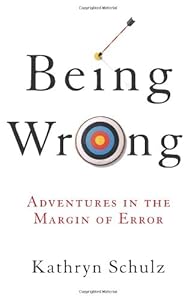
I picked up Being Wrong by Kathryn Schulz at the library after noticing it was on my Amazon recommendations. Schulz explores why it is so hard for us to admit being wrong (especially without the phrase "I was wrong, but..."), the plus side of error, big mistakes and trivial mistakes, why everyone makes mistakes, how we view those mistakes in retrospect, the process we go through when we change our minds about something we were once certain about, and so much more.
If you are a non-fiction reader, you will probably want to check this one out. There are some drier parts of the book but Schulz's debut is also full of fascinating research and anecdotes.
A few excerpts:
As with dying, we recognize erring as something that happens to everyone, without feeling that it is either plausible or desirable that it will happen to us. Accordingly, when mistakes happen anyway, we typically respond as if they hadn't, or as if they shouldn't have: we deny them, wax defensive about them, ignore them, downplay them, or blame them on somebody else. p.6
Doctors don't teach medical students the theory of bodily humors, and astronomy professors don't teach their students to calculate the velocity of the fifty-five concentric spheres Aristotle thought composed the universe. This is practical and efficient pedagogy, but it shores up our tacit assumption that current belief is identical with true belief, and it reinforces our general sense of rightness. p. 21
Believing something on the basis of messy, sparse, limited information really is how we err. But it is also how we think. What makes us right is what makes us wrong. p.122
In the optimistic model of wrongness, error is not a sign that our past selves were failures and falsehoods. Instead, it is one of those forces, like sap and sunlight, that imperceptibly helps another organic entity -- us human beings -- to grow up. p. 289
As soon as we think we are right about something, we narrow our focus, attending only to details that support our belief, or ceasing to listen altogether. By contrast, when we are aware that we could be wrong, we are far more inclined to hear other people out. p. 310
And finally,
Being wrong is hard and humbling, and sometimes even dangerous, but in the end it is a journey, and a story. Who really wants to stay home and be right when you can don your armor, spring up on your steed and go forth to explore the world? True, you might get lost along the way, get stranded in a swamp, have a scare at the edge of a cliff; thieves might steal your gold, brigands might imprison you in a cave, sorcerers might turn you into a toad -- but what of that? To fuck up is to find adventure: it is in that spirit that this book is written. p.42-43


I'm just getting to this now. I may read this book.
ReplyDeletePossibly the single most important shift in my thinking that carried me from fundamentalism to mysticism and spiritual adventure was fully internalizing intellectual humility. And absolutely every part of my life is better for it.
Here's to fucking up!
Crazy stuff, eh? I'm working at saying "I was wrong" with only a period following it. :)
ReplyDelete